

Hey there, if you’re working with extruded aluminium T slots (you can check out our go-to page for the basics right here: Extruded Aluminium T Slot), you know surface treatments aren’t just a “nice to have.” They’re what turn a basic aluminium profile into something that stands up to daily wear, looks good for years, and even boosts the performance of the whole build. I’ve been selling these T-slot profiles for 8 years now, and I can’t tell you how many times customers come in thinking “aluminium is aluminium”… until their project falls apart because they skipped a key treatment.
Today I’m breaking down all the main surface treatments we offer (plus a few others worth knowing about) and when to pick each one. No stuffy jargon, just real talk that’s helped hundreds of our clients—from small workshop owners to big automation companies—get the right finish for their needs.
First, let’s circle back to what exactly we’re talking about with these profiles, because sometimes even regulars mix up terms. A lot of people use Aluminium T Slot Profile interchangeably with other groove-style aluminium parts, but T slots are specifically designed for mounting fasteners, so their surface treatment needs to play nice with sliding those bolts and nuts in. Then there are variants like U-Shaped Groove Aluminum Profile for slightly different uses, or even Aluminum U-channel Strip for smaller trim pieces, but when it comes to load-bearing T slot builds, surface prep is non-negotiable.
Wait, quick side note: if you’re new here, our Extruded T Slot Aluminum line is made from 6063-T5 alloy, which is the sweet spot for T slots—it’s easy to machine, strong enough for most framing, and takes surface treatments way better than cheaper alloys. But even the best base material can get ruined with a bad surface treatment, so let’s dive in.
1. Anodizing: The Workhorse We Recommend 90% of the Time
Hands down, anodizing is our top-seller and what we suggest for almost every project. If you’ve ever seen a shiny, scratch-resistant aluminium bike frame or a patio railing, that’s anodizing. Here’s how it works, in plain English: instead of painting the surface, we dip the T slot profile in an electrolytic solution that makes aluminium oxide (the same stuff that forms naturally on aluminium, but way thicker and more controlled).
The benefits here are huge. First, it’s way more durable than paint. We’ve had customers with anodized T slot frames for their automated assembly lines that have been running 12 hours a day, 6 days a week, for 5 years—no scratches, no fading, no peeling. It’s also corrosion-resistant, so if your project is going outdoors (think greenhouse frames or trade show displays that get moved around), anodizing won’t turn chalky or get pitted in rain or humidity.
Another win: it’s low-maintenance. Wipe it down with a damp cloth and it looks good as new. We offer a range of anodized finishes, too: clear (so you see the natural silver aluminium), black, silver, even custom colors like blue or red for branding. The only catch? It’s not as cheap as some other options if you’re on a super tight budget, and if you need a super high-gloss mirror finish, you’ll want to specify that—standard anodize is a smooth satin.
Wait, pro tip: for T slot specific builds, always ask for the anodizing to be applied evenly across the T groove sides. Some cheaper anodizing jobs leave the inside of the groove thin, which can make sliding nuts and bolts tricky. We make sure our anodize is uniform even in those tight T slots, so no fastener snags.
2. Powder Coating: For Bold Colors and Extra Durability
If anodizing’s too plain or you need a custom bright color, powder coating is the way to go. This is a dry paint process: we spray a powder-based pigment onto the T slot profile, then bake it in an oven so it melts and forms a hard, protective layer. It’s thicker than wet paint, so it’s even more scratch-resistant in some cases.
We see powder coating a lot for custom projects: trade show booths that need brand colors, workshop partitions, or even kids’ play structures made with T slots. It comes in every color under the sun—matte, gloss, metallic, even textured finishes like wood grain for that warm factory look. The downside? It can chip if you drop something heavy on it, and over time, direct sunlight might make brighter colors fade a little (though high-quality powder coat fades way less than cheap spray paint).
Another thing to watch for with T slots: if you get powder coating on the inner walls of the T groove, it can interfere with fastener movement. That’s why we offer “groove-only” powder coating for T slots—we mask the inside of the groove so only the outer surface gets color, keeping the sliding action smooth. It’s a small extra step, but it makes a huge difference for our customers’ builds.
3. Mechanical Polishing: For a Shiny, Decorative Finish
If your T slot is going to be on display—like in a retail display stand or a custom furniture frame—mechanical polishing is the way to get that mirror-like shine. This process uses abrasive wheels and compounds to buff the aluminium surface smooth, removing all the small imperfections from extrusion. It’s not just pretty, though: polished aluminium is also very reflective, which is why it’s popular for lighting fixtures.
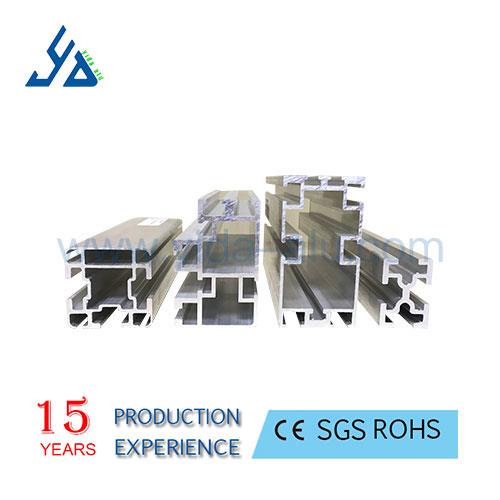

But here’s the thing: polished surfaces are way more prone to scratches if they’re in a high-wear area. I once had a customer who got polished T slots for a workshop workbench frame, and after a month of dragging tools, they were full of scuffs. He ended up switching to anodizing because he liked the shine but needed durability. So save polishing for parts that are mostly decorative or in low-wear zones—don’t put it on the side of a forklift that’s going to bump into things.
Also, polished T slots don’t have the same corrosion resistance as anodized or powder-coated ones, so if they’re outdoors, you’ll need to seal them after polishing to prevent tarnishing.
4. Electrophoretic Coating (E-Coating): The Middle Ground
I like to think of e-coating as the middle kid between anodizing and powder coating. It’s similar to painting, but uses electricity to bind the paint to the aluminium surface, so it’s more even than wet paint, especially on the edges and crevices of T slots. It’s thinner than powder coating, so it doesn’t add as much bulk, which is good if you’re working with tight tolerances on your build.
E-coating is affordable, has good corrosion resistance, and comes in basic colors (usually black or gray). We use it for smaller parts like aluminum U-channel strips or small T slot brackets that don’t need super heavy-duty protection but still need to look neat. The downside? It’s not as durable as anodizing or powder coating—scratches can go through the layer easier, so it’s better for indoor projects.
5. Passivation: The No-Cost (Almost) Treatment for Raw Aluminium
Wait, not all surface treatments are for looks. If you’re working with T slots that are going to be for food processing equipment or medical devices, passivation is a must. This is a chemical process that removes free iron from the surface of the aluminium, preventing corrosion and making it resistant to staining. It’s super cheap (almost just a dip in a solution) and doesn’t change the look of the aluminium at all—it’s still the natural silver color.
We do a lot of passivation for customers in the food and pharma industries, because they need surfaces that won’t leach contaminants. It’s also good if you’re storing T slots for a long time—passivated surfaces don’t tarnish as easily as raw aluminium.
6. Avoiding Common Mistakes I See All the Time
Over 8 years in this business, I’ve seen so many customers mess up their surface treatment choice. Let me save you the headache:
- Don’t get powder coating if your T slot is going to have heavy fastener movement. The thick layer can make nuts stick, or even wear through over time.
- Don’t use polished T slots outdoors unless you seal them. I’ve had clients come back asking why their shiny display stand turned dull and gray after a year outside.
- Always ask about groove surface quality. A lot of extrusion suppliers rush surface treatments and skip preping the inside of the T slot. Our Extruded Aluminium T Slot line has prepped grooves that work with any treatment, so you never have snags.
Another quick tip: if you’re ordering custom-length profiles, tell us the surface treatment early. Some treatments have slight dimensional changes (like anodizing can make the part shrink a tiny bit), so we can adjust the extrusion length to compensate, so your final build fits perfectly.
Final Thoughts: Pick the Treatment That Fits Your Project (Not the Cheapest One)
At the end of the day, the best surface treatment for your Extruded T Slot Aluminum depends on what you’re using it for. If it’s an indoor automation frame, anodizing is perfect. If it’s a trade show booth, powder coating in your brand color is a no-brainer. If it’s for a food machine, passivation is non-negotiable.
We’ve got all these treatments in-house, so we can customize any Aluminium T Slot Profile to your exact needs—no middlemen, no delays. We’ve worked with everyone from small startups building their first workshop to Fortune 500 companies rolling out new product lines.
If you’re not sure which treatment is right for your project, just reach out. We can send you samples of each finish, answer any questions, and even help you spec the right profile for your build. Don’t waste time and money guessing—let’s make sure your T slot parts are exactly what you need, from the first extrusion to the final finish.
References
- ASM International. (2019). Surface Treatments for Aluminium Alloys. Metals Handbook, Volume 5: Surface Engineering.
- TIG Alu. (2021). A Guide to T-Slot Aluminum Profile Surface Finishes. Industrial Metal Fabrication Journal.
- Aluminium Association. (2020). Corrosion Resistance of Anodized and Coated Aluminium Extrusions.
Wait, quick add-on for clarity: if you’re checking out different variants, our U-Shaped Groove Aluminum Profile line has similar surface treatment options, and Aluminum U-channel Strip can be treated too, though those are more for secondary parts. All our T slot profiles, no matter the variant, get the same quality surface prep. If you’re ready to order or just have questions about surface treatments, get in touch with our team to talk through your project details.


