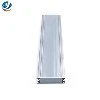
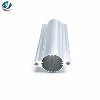
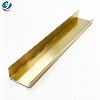
Extruded aluminum guide rails have notable environmental advantages. Aluminum can be recycled infinitely without degradation of mechanical properties. The energy consumption for remelting recycled aluminum is only 5%–8% of that of primary aluminum, cutting carbon emissions by over 90%. All scraps and cuttings generated during extrusion can be fully recycled and remelted. Old aluminum guide rails from decommissioned equipment can also be completely recovered to produce new extruded profiles, complying with circular economy principles, EPR and EPD requirements.
Aluminum guide rails are about one-third the weight of steel rails at the same strength. Their lightweight design reduces carbon emissions during transportation and lowers power consumption during equipment operation. Hollow extruded sections can be adopted to save material while maintaining structural rigidity.
Aluminum naturally forms a self-healing oxide film. After anodizing or powder coating, extruded aluminum guide rails deliver superior corrosion resistance compared with ordinary carbon steel. They require minimal maintenance and fewer replacements, lowering material consumption and chemical pollution over the service life, and meet RoHS and REACH standards.
Extrusion enables one-step forming of complex cross-sections such as T-slots, dovetail grooves and half-D profiles. It reduces CNC machining and welding work, cutting the use of cutting fluids and welding consumables.
Limitations to note
Primary aluminum has a high carbon footprint due to power-intensive electrolysis. Carbon emissions can be greatly reduced by using recycled aluminum billets, hydro-powered aluminum or green-power aluminum. Pollution risks exist in conventional surface treatment processes. Chrome-free passivation and eco-friendly powder coating are recommended to satisfy European and American green procurement standards. Aluminum smelting and extrusion still consume energy and are not carbon-free.
Quick comparison
Extruded aluminum guide rail: long service life, infinitely recyclable, lightweight; high carbon for primary aluminum, low carbon for recycled aluminum.
Carbon steel guide rail: lower carbon footprint for raw material, prone to rust and requires regular anti-corrosion maintenance; material performance degrades after repeated recycling.
Engineering plastic guide rail: lightweight, but hard to recycle and degrade after aging, creating solid waste issues.