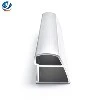
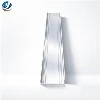
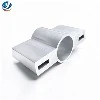
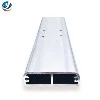
Aluminum skirting boards are gradually replacing wooden, PVC, and regular stainless steel skirting boards thanks to their structural strength and long-lasting stability, making them a preferred material for building finishing systems. By referring to the GB/T 3880.2-2012 standard for building aluminum and authoritative test data, we can break down the strength performance of aluminum skirting, offering a useful reference for project procurement and home decoration material selection.
Baseboards are constantly subjected to bumps, pressure, and changes in temperature and humidity, so material strength and resistance to deformation are key factors. Traditional PVC can easily crack, wooden baseboards can warp when damp, and stainless steel can dent or scratch easily. Aluminum baseboards use **6063-T5 national standard aluminum alloy as the base material, formed by extrusion and T5 aging heat treatment, balancing strength and toughness.
Mechanical testing shows this profile has a tensile strength of 160–180MPa, yield strength ≥110MPa, elongation of 8%, Brinell hardness of 13–15HW, and excellent scratch resistance. The regular 1.2mm commercial version can withstand impacts up to 15J, while the 2.0mm thick heavy-duty version reaches 22J, handling heavy moving objects and furniture collisions. Its static load capacity is 250–380kg/m, making it hard to bend or deform under stepping or heavy pressure.
At the same time, the profile has uniform internal stress and its dimensional tolerance is controlled within ±0.1mm, making it resistant to warping or twisting under temperature changes. With anodizing and powder coating surface treatments, it keeps the strength of the base material while being moisture- and corrosion-resistant, so its mechanical performance won't degrade over time in humid environments, giving it a much longer lifespan than traditional baseboards.
It's suitable for use throughout homes as well as in high-traffic commercial spaces like offices, hotels, schools, and hospitals. It's highly durable and easier and cheaper to maintain or replace later on.
Aluminum baseboards take advantage of the mechanical strengths of aluminum alloys, addressing the common issues of traditional baseboards being easily damaged and not very durable. They offer both a metallic feel and structural reliability, fitting perfectly with the trend of low-maintenance, long-lasting building decor. In the future, high-strength aluminum finishing profiles will be used more widely in complete interiors and construction projects, helping to upgrade the quality in the finishing and trim sector.