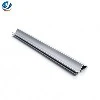
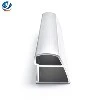
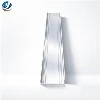
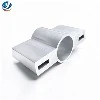
Aluminum extrusion and cold drawing are two complementary forming processes widely used in the aluminum fabrication sector. In most cases, drawn profiles start as extruded blanks for further finishing. They differ significantly in manufacturing principle, section capability, dimensional accuracy, mechanical performance and end-use suitability.
Manufacturing Process
Extruded aluminum profiles are formed by hot working. Aluminum billets are heated to 400–500°C and forced under high pressure through a custom die. The metal flows plastically to take the designed cross-section in one forming step.
Drawn aluminum profiles, or cold-drawn profiles, are processed at ambient temperature. A pre-formed extruded tube, rod or simple profile is pulled through a smaller die. A mandrel can be used to control the inner bore. The material undergoes cold plastic reduction to tighten dimensions and improve uniformity. Complex multi-cavity shapes cannot be made directly by drawing.
Cross-section Flexibility
Extrusion delivers high design freedom. It supports multi-cavity, ribbed, hollow and intricate custom shapes, including architectural trim, heat sinks, cabinet handles, support brackets and decorative edging strips. Custom die opening is available for project-specific requirements.
Cold drawing is limited to relatively simple geometries: round tubes, solid round bars, square bars and basic simple profiles. It is not suitable for complex structural sections with multiple internal ribs.
Tolerance & Surface Quality
Extruded profiles follow standard industrial tolerances. Dimensional variation may come from cooling shrinkage and straightening. Minor extrusion lines can appear on the surface, which can be covered or enhanced by anodizing, powder coating or other post-finishing treatments.
Cold-drawn products achieve tighter tolerances and more consistent wall thickness. They typically have a smoother, brighter surface, making them ideal for precision fit, sliding assemblies and pressure-critical tubing.
Mechanical Properties
The mechanical properties of extruded aluminum depend on the alloy and temper condition, such as 6063-T5. Grain structures align along the extrusion direction, and strength can be adjusted via solution heat treatment and artificial aging.
Cold drawing introduces work hardening. The material gains higher tensile strength and hardness while ductility decreases. Annealing may be applied afterward to restore flexibility if required.
Cost, Lead Time & Production
Extrusion molding is the mainstream solution for mass production and custom sections. It offers buyers lower unit costs, flexible mold changes, and fast new product development.
Cold drawing usually adds extra processing steps, pushing up labor and production costs. It is selected when the extruded blank cannot meet strict requirements for precision, concentricity or surface finish.
Typical Applications
Extruded aluminum profiles: Window and curtain wall frames, industrial framing, heat sinks, furniture aluminum handles, decorative trim, solar brackets and general structural components.
Drawn aluminum profiles: Precision aluminum tubing, hydraulic and refrigeration piping, solid precision bar stock, telescopic tubes, instrument parts and close-tolerance sliding components.