With the growing demand for photovoltaic, new energy, industrial automation, LED heat dissipation and automotive lightweight applications, aluminum profiles have evolved from basic extrusion forming to diversified deep processing technologies. Different processing methods match different precision, batch and appearance requirements, forming the core of one-stop custom aluminum product manufacturing.
1. Forming Processes (Preliminary Foundation)
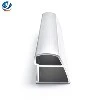
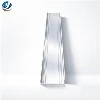
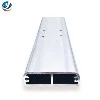
Hot Extrusion: Aluminum billets are heated and forced through custom dies under high pressure to form fixed cross-sections in one pass (solid, hollow, multi-cavity cooling fins). It is the primary process for most aluminum profiles. After forming, the profiles are cooled, stretched and artificially aged (T5/T6) to stabilize hardness and straightness. Suitable for mass custom molding, such as heat sinks, photovoltaic frames and equipment frame profiles.
Cold Extrusion: Formed at room temperature with smooth surface and minimal deformation. Mainly used for small precision aluminum parts and connection terminals.
2. Cutting & Sawing
CNC Sawing: The most common method. Supports straight cuts, 45° miter cuts and multi-angle cutting for frames and window profiles, ensuring end-face perpendicularity for regular batch cutting.
Laser Cutting: Non-contact cutting with clean edges for special-shaped grooves and complex contours. Note: thermal deformation may occur, so thin-walled profiles are not recommended.
Waterjet Cutting: Cold cutting with no heat-affected zone. Ideal for thick-walled profiles and profiles already finished with surface treatment; it will not damage anodized films or coatings. Higher cost.
3. Machining (Precision Deep Processing, Widely Used for Foreign Custom Orders)
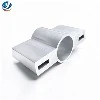
CNC Milling: Machining centers complete grooving, surface milling, cavity machining, steps and special-shaped notches. Tolerance can reach ±0.03 mm. It is the key process for equipment housings, heat sink bases and automation modules, suitable for prototype sampling and mass production.
Drilling, Countersinking & Tapping: Pre-mount holes and threaded holes for assembly. For thin-walled profiles, spindle speed must be controlled to avoid edge chipping and thread slipping.
Stamping & Punching: Punch round holes, long slots and snap notches with punch presses. Much higher efficiency than CNC, perfect for standardized mass production, though tooling cost is high.
Bending & Roll Bending: For curved profiles and arc frames. Aluminum has obvious springback, so springback compensation is required in advance. Applied to curved decorative strips and curved handrails.
Welding: TIG welding and laser welding for profile splicing and frame assembly. Aluminum is prone to oxidation during welding; weld seams need grinding after welding.
4. Surface Finishing & Marking
Grinding, Polishing & Sandblasting: Remove tool marks and burrs. Sandblasting delivers matte texture, while polishing achieves mirror finish, preparing the surface for subsequent anodizing.
Anodizing, Electrophoresis, Powder Coating & Fluorocarbon Coating: Improve corrosion resistance, wear resistance and color performance, widely used for construction and cosmetic parts.
Laser Marking & Silk Screening: Print logos, model numbers and parameters, commonly used for traceability of export products.
5. Auxiliary Processes
Deburring, straightening, degreasing cleaning, assembly and inspection (CMM, roughness testing) to guarantee tolerance and consistency of finished goods.
Process Selection Guide
Fixed cross-section, large batch: Hot extrusion + sawing + punching for optimal cost.
Complex structure, high precision, small-batch multi-spec: CNC machining is preferred.
Profiles already anodized or coated, heat-sensitive: Waterjet cutting.
Cosmetic parts: Match with sandblasting, anodizing or electrophoresis after machining to boost weather resistance.