

Elasticity is a fundamental mechanical property that plays a crucial role in determining the performance and suitability of materials for various applications. As a leading supplier of Aluminium Angle Trim, I often encounter questions regarding the elasticity of this versatile product. In this blog post, I will delve into the concept of elasticity, explore the factors influencing the elasticity of Aluminium Angle Trim, and highlight its implications for real - world applications.
Understanding Elasticity
Elasticity refers to a material's ability to deform under the application of stress and then return to its original shape once the stress is removed. This property is critical as it enables materials to withstand forces without undergoing permanent damage. The key measure of elasticity is the elastic modulus, also known as Young's modulus. Young's modulus (E) is defined as the ratio of stress (σ) to strain (ε) within the elastic range of a material, represented by the formula (E=\frac{\sigma}{\varepsilon}).
Stress is the force applied per unit area ((\sigma = \frac{F}{A}), where (F) is the force and (A) is the cross - sectional area), and strain is the relative deformation of the material ((\varepsilon=\frac{\Delta L}{L_0}), where (\Delta L) is the change in length and (L_0) is the original length). A high elastic modulus indicates that a material is stiffer and requires more force to produce a given amount of deformation.
Elasticity of Aluminium Angle Trim
Aluminium is known for its relatively good elasticity. The elastic modulus of pure aluminium is approximately 69 GPa (gigapascals). However, Aluminium Angle Trim is often made from aluminium alloys, and the specific elastic modulus can vary depending on the alloy composition.
Alloy Composition
Different alloying elements are added to aluminium to enhance its mechanical properties, including elasticity. For example, alloys containing magnesium and silicon, such as the 6063 alloy commonly used in Aluminium Angle Trim, can have a slightly different elastic modulus compared to pure aluminium. These alloying elements can form intermetallic compounds within the aluminium matrix, which affect the material's internal structure and, consequently, its elasticity.
Heat Treatment
Heat treatment is another important factor influencing the elasticity of Aluminium Angle Trim. Processes like annealing can relieve internal stresses in the material and potentially improve its ductility, which is related to elasticity. Annealing involves heating the aluminium to a specific temperature and then slowly cooling it. This process can help to homogenize the microstructure of the alloy, reducing the number of defects and making the material more responsive to elastic deformation.

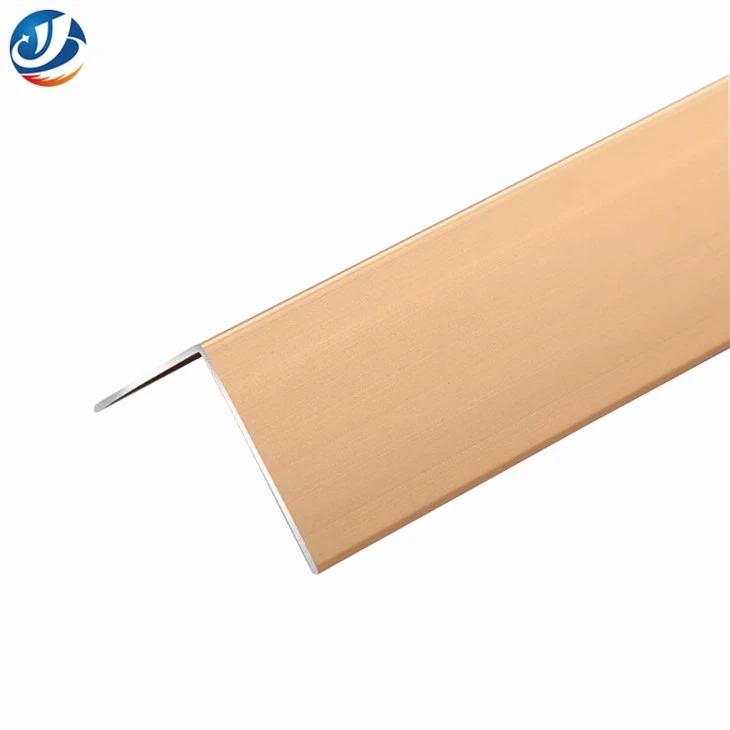
Manufacturing Process
The manufacturing process of Aluminium Angle Trim, such as extrusion, can also impact its elasticity. Extrusion involves forcing the aluminium alloy through a die to create the desired shape. During extrusion, the material undergoes a significant amount of plastic deformation. However, the proper control of extrusion parameters, such as temperature and extrusion speed, can ensure that the final product retains good elastic properties.
Applications and Implications of Elasticity
The elasticity of Aluminium Angle Trim has several important implications for its applications.
Construction
In the construction industry, Aluminium Angle Trim is widely used for edging and finishing. Its elasticity allows it to be easily bent and shaped on - site to fit different angles and contours. For example, when installing it around curved corners or irregularly shaped structures, the ability to deform elastically without breaking is crucial. This flexibility reduces the need for complex cutting and joining operations, saving time and labor costs. You can find a variety of Aluminium Angle Trim for construction applications on our website, including Polished Aluminium Angle Trim and Anodised Aluminium Angle Trim.
Furniture Manufacturing
In furniture manufacturing, Aluminium Angle Trim is used to protect the edges of tables, cabinets, and other furniture pieces. The elasticity of the trim allows it to absorb impacts and vibrations, preventing damage to the furniture. When a piece of furniture is bumped or jostled, the trim can deform elastically and then return to its original shape, providing long - term protection. Our Aluminum Arc Extenar Conas Edge Strips are popular choices for furniture manufacturers due to their excellent elastic properties.
Automotive and Aerospace Industries
The automotive and aerospace industries also benefit from the elasticity of Aluminium Angle Trim. In automotive applications, it can be used for interior trim, providing a finished look while also withstanding the vibrations and impacts associated with vehicle operation. In aerospace, where weight savings are critical, the elasticity of aluminium trim allows it to be used in areas where it needs to flex slightly without failure. Our Aluminium Angle Extrusion products are designed to meet the high - quality and performance requirements of these industries.
Quality Control and Testing
As a responsible supplier of Aluminium Angle Trim, we conduct rigorous quality control and testing to ensure that our products meet the required elastic standards. This includes tensile testing, where a sample of the trim is subjected to a gradually increasing tensile force until it reaches its elastic limit. By measuring the stress and strain during this process, we can accurately determine the elastic modulus of the material.
We also perform bend testing to evaluate the ability of the Aluminium Angle Trim to deform elastically. Samples are bent to a specific angle and then released to check if they return to their original shape. These tests help us to identify any potential issues with the elasticity of our products and make necessary adjustments to our manufacturing processes.
Importance of Elasticity in Product Selection
When customers are selecting Aluminium Angle Trim for their projects, the elasticity of the product is an important consideration. For applications where the trim needs to be bent or shaped, a higher degree of elasticity is preferred. On the other hand, for applications where the trim needs to provide rigid support and maintain its shape under load, a stiffer material with a relatively high elastic modulus may be more suitable.
Our Aluminum Angle Edge Trim is available in various alloys and specifications, allowing customers to choose the product that best meets their specific elasticity requirements. Whether you need a highly flexible trim for a curved installation or a more rigid one for a load - bearing application, we have the right solution for you.
Conclusion
The elasticity of Aluminium Angle Trim is a complex yet crucial property that affects its performance in a wide range of applications. Through careful control of alloy composition, heat treatment, and manufacturing processes, we can produce Aluminium Angle Trim with the desired elastic properties. Our commitment to quality control and testing ensures that our products meet the highest standards of elasticity and performance.
If you are in the market for high - quality Aluminium Angle Trim, we invite you to explore our range of products. Whether you are a construction professional, furniture manufacturer, or involved in the automotive or aerospace industries, we have the expertise and products to meet your needs. Contact us today to start a discussion about your project requirements and discover how our Aluminium Angle Trim can enhance your products and applications.
References
- Callister, W. D., & Rethwisch, D. G. (2018). Materials Science and Engineering: An Introduction. Wiley.
- Ashby, M. F., & Jones, D. R. H. (2012). Engineering Materials 1: An Introduction to Their Properties and Applications. Butterworth - Heinemann.


