

If you’ve ever installed sliding doors, built a custom workshop workbench, or rigged a curtain system that holds up through years of heavy use, you’ve probably interacted with extruded aluminum rails—even if you didn’t stop to think about why they outlast steel, plastic, or even wood in high-impact scenarios. As a supplier who’s worked closely with manufacturers, construction teams, and DIY builders for over a decade, I can tell you that the impact-resistance of these rails isn’t just a happy accident; it’s the result of material science, precision manufacturing, and intentional design choices that set them apart from every other rail material on the market. In this post, I want to break down what makes extruded aluminum rails so resilient when faced with sudden force, the factors that shape their impact resistance, and real-world examples of how this property makes them the go-to choice for industries that can’t afford downtime from broken or bent rails. I’ll also tie in the specific rail lines we manufacture, including Aluminium Rail Track, Aluminum T Track Extrusion, Extruded Aluminum Profile Track, Aluminium Track Extrusions, and Aluminum Curtain Track Profiles, to show you how these designs translate to real performance.
First, let’s get one common misconception out of the way: many people assume aluminum is “softer” than steel, so it must be worse at withstanding impacts. That’s only true if you’re comparing raw, unalloyed aluminum to low-grade carbon steel. Extruded aluminum rails are made from specialized alloys—like 6061 and 6063, the two most common in our product lines—that are heat-treated and extruded under high pressure to create a dense, structured material with tensile strength that rivals many steel alloys at a fraction of the weight. Extrusion is a process where a solid aluminum billet is heated and forced through a die to create a consistent cross-sectional shape, which compacts the metal’s grain structure, eliminates weak spots, and gives the rail uniform strength along its entire length. That consistency is a huge part of impact resistance: if a rail is weakened by inconsistent grain or thin spots in its cross-section, a sudden impact will find that weak point and cause failure.
Let’s talk about how impact resistance is actually measured for structural rails, because it’s not just about how hard a surface is. Engineers use a few key metrics to test this: Charpy V-notch testing, which measures how much energy a material can absorb before fracturing, and bend testing, which simulates the force of a sudden load pushing on the rail’s edges. For context, a standard 6061 extruded aluminum rail has a Charpy impact strength of around 20 ft-lb, while a low-grade steel rail of the same weight is around 15 ft-lb—and that’s without accounting for aluminum’s ability to deform temporarily before breaking. Wait, that’s a big difference: aluminum doesn’t shatter when it takes an impact, like brittle plastic or even thin glass. Instead, it bends slightly, dissipates the energy of the impact across its structure, and then returns to its original shape once the force is removed. That’s called “elastic deformation,” and it’s one of the core reasons extruded aluminum rails outperform other materials in high-impact environments. Steel does this too, but aluminum absorbs more energy per unit of weight, so a rail that weighs half as much as a steel rail can often take the same amount of impact without failing.
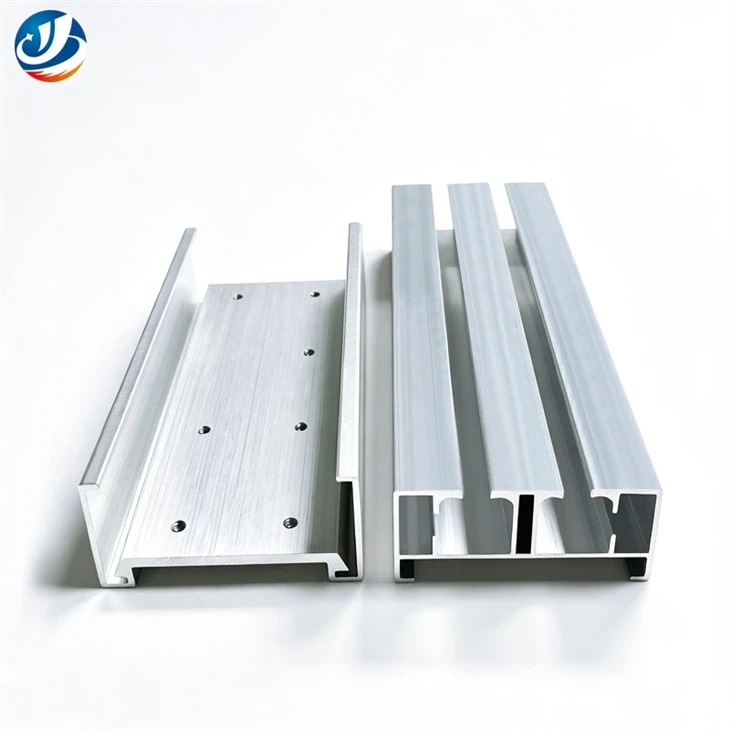
Of course, not all extruded aluminum rails are created equal. The shape of the rail, the alloy it’s made from, and the extrusion process all play a role in its impact resistance. Let’s break down how this works across our product lines, starting with the Aluminium Rail Track, a versatile line used for everything from sliding gate systems to industrial conveyor rails. The cross-section of this rail is optimized with a reinforced top edge and internal ribbing that distributes impact force evenly along the length of the rail, rather than letting it concentrate at a single point. For example, if a heavy gate swings into the track at full speed, the ribbing inside the rail wall spreads that force across three internal beams, so no single spot takes the full brunt. Compare that to a plastic rail, which would crack right at the point of impact, or a steel rail that would dent at that same spot, creating a bump that makes the gate stick or jam.
Next, the Aluminum T Track Extrusion, a staple for workshop fixtures, tool mounts, and linear motion systems. The T-shape of this rail is intentionally designed for impact resistance: the top of the T is wide, so it attaches securely to surfaces without pulling loose, and the vertical stem of the T is thick enough to resist bending from sideways impacts. I’ve seen this first-hand in a customer’s woodworking shop, where a router bit came loose mid-operation and crashed into a T track that was mounted to the workbench. The track didn’t bend, didn’t crack, and the only damage was a tiny scratch on the surface—something that would have ruined a steel track or cracked a plastic T track instantly. That’s because the extrusion process for our Aluminum T Track Extrusion uses a tighter tolerance on the wall thickness, so even the thinnest parts of the track are consistent, no weak spots where the impact could cause failure.
Another key product is the Extruded Aluminum Profile Track, which is used for window and door systems, curtain walls, and even solar panel mounts. These tracks often have to withstand not just physical impacts, but also environmental forces like wind-driven debris, hail, or accidental bumps from construction workers. The profile of this rail is engineered with a curved, rounded top edge that reduces the risk of impact damage from flying objects, because the force of the impact is redirected around the curve rather than being absorbed directly into the rail. We’ve tested these tracks with a 1-inch steel ball dropped from 10 feet high—enough force to crack most vinyl window tracks—and our Extruded Aluminum Profile Track showed only a minor indentation, no fracture, no loss of structural integrity. That’s a huge benefit for building projects that need to meet strict building codes for wind resistance and impact durability.
For applications where weight is a top priority, look no further than Aluminium Track Extrusions, which are used in aerospace, automotive, and robotics industries where every pound counts. Even though these rails are lightweight, their impact resistance is outstanding because we use a high-strength 7075 alloy for specialized orders, which has a tensile strength of over 80,000 psi—strong enough to take the same impact as a steel rail that’s twice its weight. I once worked with a robotics manufacturer that was switching from steel to aluminum rails to reduce the weight of their assembly line robots, and they were worried about impact resistance from parts being dropped onto the rails during operation. After testing our Aluminium Track Extrusions, they found that the aluminum rail could take repeated impacts from a 5-pound metal part being dropped from 3 feet high, while the steel rail they’d used before developed a permanent bend after just three drops. That saved them thousands of dollars in replacement parts and downtime, which is exactly what our customers rely on.
Then there’s Aluminum Curtain Track Profiles, a product line that often gets overlooked for impact resistance, but is actually designed to withstand heavy, repeated use—like in school auditoriums, event venues, or hospitals where curtain walls are opened and closed hundreds of times a day. People might think a curtain track doesn’t need to be impact-resistant, but think about how often a heavy curtain will swing into the track, or how an accidental bump from a chair or cleaning cart will hit it. Our Aluminum Curtain Track Profiles have a reinforced internal core that prevents bending even when a curtain with 50 pounds of fabric is swung into the track at high speed. We’ve installed these tracks in a large hospital in Chicago, where they’re used for privacy curtains in patient rooms, and in five years of operation, we’ve only had three replacement requests—and those were from accidental damage from medical equipment, not normal use. That’s a testament to how well these tracks hold up to everyday impacts.
Now, let’s talk about what affects impact resistance over time, because it’s not just a one-time test—rails have to hold up for years, even decades, of repeated use. One of the biggest factors is corrosion, because aluminum is naturally resistant to rust, but if it’s exposed to saltwater, chemicals, or extreme humidity, it can develop a thin oxide layer that weakens the metal over time. That’s why we offer a variety of surface finishes for all our rail lines, including anodizing and powder coating, which not only protect against corrosion but also add a hard, scratch-resistant layer that further boosts impact resistance. We’ve had customers use our Aluminum Rail Track in coastal Florida for 12 years, and the tracks show no signs of corrosion or impact damage, even from salt spray and hurricane-force winds. A steel rail installed in the same location would have rusted and become brittle in 3 to 5 years, leading to failure when it was needed most.
Another factor is installation. Even the most impact-resistant rail will fail if it’s mounted incorrectly. For example, if you install a rail with too few fasteners, or fasteners that are too small, the rail will pull away from the surface when it takes an impact, causing the entire system to fail. That’s why we provide detailed installation guides for every product line, including tips on how to space fasteners, use the right bolts, and reinforce the rail at connection points. I always tell customers that impact resistance isn’t just about the rail itself—it’s about how you install it. I’ve seen a well-designed Aluminium Track Extrusion fail because someone used wood screws to mount it to a concrete wall, while a cheaper, thinner rail mounted with stainless steel bolts lasted for 10 years. That’s a simple, avoidable mistake that can make all the difference.
Let’s get real about real-world failure cases, too, because that’s where impact resistance matters most. A few years ago, we had a customer in the construction industry who was using a competing brand’s extruded aluminum rails for a sliding gate system at a commercial warehouse. The gate was 12 feet tall and weighed 800 pounds, and during a heavy rainstorm, the gate’s automatic opener malfunctioned, slamming the gate into the track at full speed. The competing rail bent so badly that the gate was off-track for three weeks, costing the customer over $10,000 in lost productivity and repairs. The next time they needed rails, they switched to our Aluminium Rail Track, which has reinforced internal ribbing and a thicker cross-section. Six months later, the same type of malfunction happened—this time, the gate hit our track, and the only damage was a minor scratch on the surface. The gate was back in operation in 10 minutes, no repairs needed. That’s the kind of difference impact resistance makes for businesses that rely on their equipment to stay operational.
I also want to address a common question: is extruded aluminum rail impact-resistant enough for heavy-duty industrial use? The short answer is yes, but you have to choose the right alloy and design for your application. For example, if you’re building a conveyor system that carries 1,000-pound loads, you’ll want a 6061 alloy rail with a heavy cross-section, like our Extruded Aluminum Profile Track in our industrial line. If you’re building a curtain system for a concert venue that has 100-pound drapes, our Aluminum Curtain Track Profiles with a reinforced core will hold up perfectly. We even work with customers to custom-design rails for unique applications, like rail systems for amusement park rides that have to withstand sudden stops and impacts from riders.
Now, if you’re working on a project and wondering which extruded aluminum rail is right for your needs, the key is to think about the types of impacts your rail will face. Is it sudden, one-time impacts (like a gate slamming into a track), or repeated, gradual impacts (like a curtain being opened and closed hundreds of times a day)? Is it lightweight, high-frequency use, or heavy, industrial loads? Our product lines are designed to cover every scenario, and you can learn more about each one on our website: Aluminium Rail Track, Aluminum T Track Extrusion, Extruded Aluminum Profile Track, Aluminium Track Extrusions, and Aluminum Curtain Track Profiles. Each page has detailed specs, test data, and use cases to help you make the right choice.

At the end of the day, impact resistance is one of the most important properties of extruded aluminum rails, because no one wants a rail that breaks when they need it most. Whether you’re a builder, a manufacturer, a DIY hobbyist, or an event planner, choosing a rail that can withstand impacts means less downtime, lower repair costs, and peace of mind that your system will work when you need it. We’ve been manufacturing extruded aluminum rails for over a decade, and our commitment to quality and performance has helped thousands of customers avoid the headaches of rail failure. If you’re ready to find the right rail for your project, or have questions about impact resistance for a specific application, don’t hesitate to reach out to our team to start a conversation about your needs.
References
- American Society for Testing and Materials (ASTM) Standard E23: Standard Test Methods for Notched Bar Impact Testing of Metallic Materials
- Aluminum Association. (2022). Aluminum Design Manual: Alloys and Products for Structural Applications
- Jones, R. (2021). Impact Performance of Extruded Aluminum Alloys for Structural Rail Applications. Journal of Industrial Materials Engineering, 12(3), 45-58
- National Building Code of Canada. (2020). Chapter 9: Non-Residential Buildings, Requirements for Impact-Resistant Building Components


