


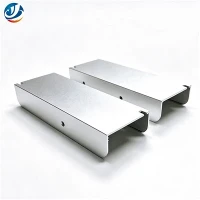

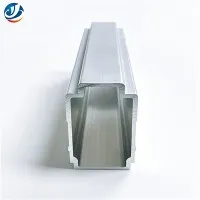


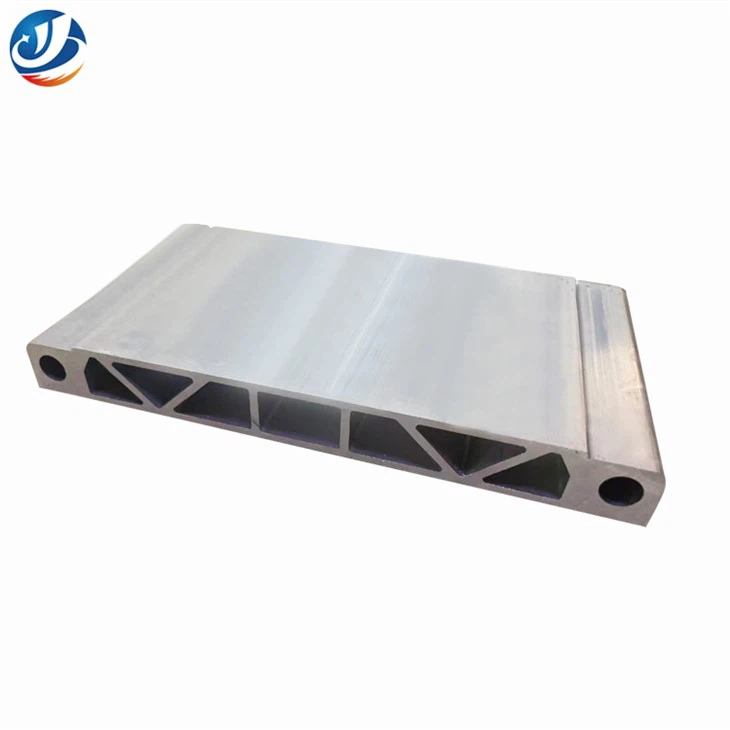


Aluminum End Plate For EV Battery Pack
Aluminum End Plate for EV Battery Pack is an aluminum structural component specially designed for electric vehicle (EV) battery packs, which are usually installed at both ends of the battery module or battery pack (axial or transverse) to ensure the structural stability, safety and electrochemical performance of the battery pack through mechanical fixation, structural support and auxiliary heat dissipation.

Product parameters
| Products name | Aluminum End Plate for EV Battery Pack |
| Material | Aluminum 6061.6063, etc |
| Size | Customized according to customer needs |
| Surface Treatment | Anodizing, electrophoresis, spraying, polishing, grinding |
| Compressive strength | simulated cell expansion force test (50-100kN pressure), deformation ≤ 0.2mm, no cracks |
| Impact resistance | In line with GB/T 31467.3 standard, no structural failure after 25g impact (15ms half sine wave) |
| Melting point | 580-650 °C, keep the structure stable in the early stage of thermal runaway (200-300 °C). |
| Waterproof rating | IP67 (no penetration after 30 minutes of immersion in 1 meter of water) |
| Machining | CNC, drilling, tapping, cutting |
| Customizable | YES |
| Temper | O,H12,H13,H14,H16,H18,H24,H32,H34,H19,H38,G36,F,H111,H112,H192,H392,H393,H321 etc |
| Application | Heat exchange, Radiator, Condenser, Evaporator,Kitchenware, food and chemical products processing and storage devices Aircraft fuel tanks, oil pipe, rivets, wire; Cans cover, car body panels, steering plates, stiffeners, brackets and other components; |
drawings

W10005

W10009

W10011

W10012

W10014

W10016


01
Excellent aluminum
Using excellent aluminum as raw material, it has good processing performance, not easy to rust, high toughness, high hardness, good corrosion resistance, and durable.
02
Fine workmanship
Spraying process and professional polishing edging, Aluminum End Plate for EV Battery Pack edges and finishes are smooth and smooth.
03
Process treatment
It has the characteristics of not easy to corrode, not easy to fade, etc., and the surface has been brushed, oxidized, polished, sandblasted, sprayed and other treatments.
04
Product cutting
Cut by a professional cutting machine, the cut product has the characteristics of high finish, no burr, etc., and the size is optional and needs to be customized.
Customized processes

Six core links
The production and manufacturing process of Aluminum End Plate for EV Battery Pack needs to be combined with material characteristics (aluminum alloy processing requirements), structural accuracy requirements (suitable for battery packaging) and performance standards (strength, flatness, etc.), and the overall can be divided into six core links: raw material preparation→ forming processing→ performance enhancement→ precision machining→ surface treatment→ quality inspection and packaging.
Three core requirements
The aluminum end plate needs to meet the three core requirements of structural strength (impact resistance, expansion resistance), assembly accuracy (adaptation to the module), and environmental resistance (anti-corrosion, insulation) at the same time, so as to ensure the safe and stable operation of the battery pack in the whole life cycle of the vehicle.

Product inspection process


The whole chain control from raw materials to finished products:
1. Raw material inspection (aluminum entry)
Material Verification
Spectral analysis: Detect aluminum alloy composition (e.g., Si, Mg, Cu content) to ensure compliance with grade requirements (e.g., 6061 needs to contain Si 0.4-0.8%, Mg 0.8-1.2%).
Mechanical property testing: tensile test (tensile strength, yield strength, elongation), hardness test (Brinell or Vickers hardness) to verify whether the heat treatment state requirements (such as T6 state) are met.
Cosmetic and defect detection
Visual or fluorescence flaw detection: Check the surface of aluminum for cracks, inclusions, peeling and other defects (these defects will cause stress concentration after processing and reduce strength).
Thickness tolerance detection: Check the thickness of the plate by micrometer or laser thickness gauge to ensure that the machining allowance is sufficient.
2. Process inspection (forming and processing)
The machining process of EV battery pack aluminum end plates is usually: cutting → CNC milling (forming → machining), surface treatment (e). g. anodizing, spraying), → drilling (mounting holes), key inspection nodes include:
Dimensional accuracy inspection
Three-dimensional coordinate measurement (CMM): detect the length, width, flatness (≤0.1mm/m) and mounting hole position tolerance (≤±0.05mm) of the end plate to ensure the assembly accuracy with the battery cell and battery pack housing (to avoid uneven force on the battery cell caused by too tight or too loose assembly).
Roughness detection: The surface of the battery cell or cooling system (Ra≤1.6μm) is measured by the roughness meter to ensure the contact tightness and improve the heat dissipation efficiency.
Structural defect detection
Ultrasonic flaw detection: Check whether there are machining cracks inside the milled end plate (especially in the stress concentration areas such as corners and hole positions).
Pressure test (for end plates with sealing requirements): If the end plate is integrated with a liquid cold plate, an air tightness test is required (e.g., filled with 0.5MPa air pressure, the pressure is maintained for 30 minutes without leakage).
3.Finished product factory inspection (final performance verification)
Appearance and surface quality
Visual inspection: Whether the surface treatment layer of the EV battery pack's aluminum end plate (such as anodized film) is uniform, does not peel off, and meets the requirements in color (usually natural or black for enhanced corrosion resistance).
Coating adhesion test: scratch grid test (cross grid with a blade, tear and pull after taping, and the coating peeling area needs to be ≤5%).
Mechanics and weather resistance verification
Compressive strength test: simulate the cell expansion force (such as applying 50-100kN pressure), detect the deformation of the end plate (need to ≤0.2mm), and no cracks.
Salt spray test: neutral salt spray (5% NaCl solution, 35°C) for 48-96 hours, the surface corrosion area needs to be ≤5%, and no coating peels off.
Assembly compatibility testing
Trial assembly with cells and housings: check the assembly gap (≤ 0.1mm) to ensure that there is no interference, and the cell is evenly stressed after fixation (monitored by pressure sensor).
Hot Tags: aluminum end plate for ev battery pack, China aluminum end plate for ev battery pack manufacturers, suppliers, factory
You Might Also Like


Send Inquiry