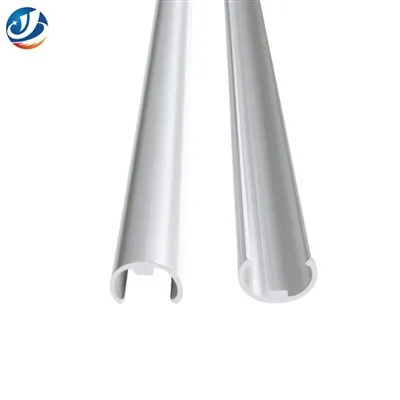
As a supplier of Aluminium T Slot Profile, I often get asked about various technical aspects of our products. One question that frequently comes up is, "What is the Young's modulus of Aluminium T Slot Profile?" In this blog post, I'll delve into this topic, explaining what Young's modulus is, its significance for Aluminium T Slot Profiles, and how it impacts the performance of these profiles in different applications.
Understanding Young's Modulus
Young's modulus, also known as the modulus of elasticity, is a fundamental property of materials that measures their stiffness. It is defined as the ratio of stress (force per unit area) to strain (deformation per unit length) within the elastic range of a material. In simpler terms, it tells us how much a material will stretch or compress under a given load.
Mathematically, Young's modulus (E) is expressed as:
[ E = \frac{\sigma}{\epsilon} ]
where (\sigma) is the stress and (\epsilon) is the strain.
The unit of Young's modulus is typically pascals (Pa) or gigapascals (GPa). A higher Young's modulus indicates a stiffer material, meaning it will deform less under a given load compared to a material with a lower Young's modulus.
Young's Modulus of Aluminium
Aluminium is a widely used metal in various industries due to its excellent combination of properties, including low density, high strength-to-weight ratio, corrosion resistance, and good formability. The Young's modulus of pure aluminium is approximately 70 GPa. However, the actual Young's modulus of Aluminium T Slot Profiles can vary depending on several factors, such as the alloy composition, heat treatment, and manufacturing process.
Most Aluminium T Slot Profiles are made from aluminium alloys, which are mixtures of aluminium with other elements such as copper, magnesium, silicon, and zinc. These alloying elements can significantly affect the mechanical properties of the aluminium, including its Young's modulus. For example, aluminium alloys with higher amounts of alloying elements tend to have higher Young's moduli compared to pure aluminium.
The heat treatment process also plays a crucial role in determining the Young's modulus of Aluminium T Slot Profiles. Heat treatment can alter the microstructure of the aluminium alloy, which in turn affects its mechanical properties. For instance, aging treatment can increase the strength and hardness of the alloy, which may also result in a slight increase in the Young's modulus.
Significance of Young's Modulus for Aluminium T Slot Profiles
The Young's modulus of Aluminium T Slot Profiles is an important parameter that affects their performance in various applications. Here are some key reasons why it matters:
Structural Integrity
In structural applications, such as machine frames, workbenches, and industrial enclosures, Aluminium T Slot Profiles need to be able to withstand various loads without excessive deformation. A higher Young's modulus ensures that the profiles are stiffer and more resistant to bending and deflection, which helps maintain the structural integrity of the overall assembly.
Precision and Accuracy
In applications where precision and accuracy are critical, such as in automation systems and robotics, the stiffness of Aluminium T Slot Profiles is essential. A higher Young's modulus reduces the amount of deflection under load, which helps maintain the alignment and positioning of components, ensuring accurate operation.

Vibration Damping
Aluminium T Slot Profiles are often used in applications where vibration damping is important, such as in machinery and equipment. A higher Young's modulus can help reduce the amplitude of vibrations, improving the overall stability and performance of the system.
Factors Affecting the Young's Modulus of Aluminium T Slot Profiles
As mentioned earlier, several factors can affect the Young's modulus of Aluminium T Slot Profiles. Here are some of the key factors:
Alloy Composition
The alloy composition is one of the most significant factors affecting the Young's modulus of Aluminium T Slot Profiles. Different aluminium alloys have different Young's moduli, depending on the type and amount of alloying elements present. For example, 6061 aluminium alloy, which is commonly used for T Slot Profiles, has a Young's modulus of approximately 68.9 GPa, while 7075 aluminium alloy, which is a high-strength alloy, has a Young's modulus of around 71.7 GPa.
Heat Treatment
Heat treatment can significantly alter the mechanical properties of Aluminium T Slot Profiles, including their Young's modulus. Different heat treatment processes, such as annealing, quenching, and aging, can result in different microstructures and mechanical properties. For example, aging treatment can increase the strength and hardness of the alloy, which may also lead to a slight increase in the Young's modulus.
Manufacturing Process
The manufacturing process used to produce Aluminium T Slot Profiles can also affect their Young's modulus. Extrusion is the most common manufacturing process for T Slot Profiles, and the extrusion parameters, such as temperature, speed, and pressure, can influence the microstructure and mechanical properties of the profiles. For example, a higher extrusion temperature may result in a coarser grain structure, which can reduce the Young's modulus of the profiles.
Applications of Aluminium T Slot Profiles
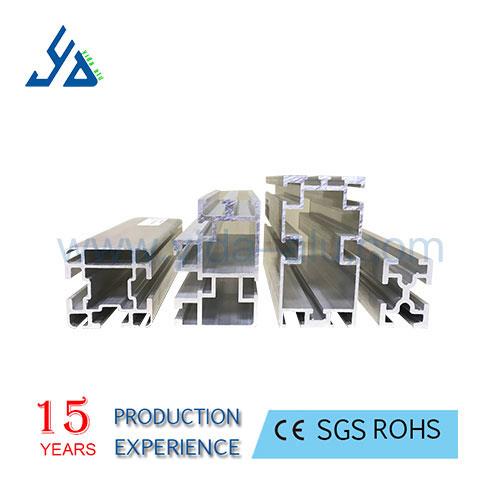
Aluminium T Slot Profiles are widely used in various industries due to their versatility, ease of use, and excellent mechanical properties. Here are some common applications of Aluminium T Slot Profiles:
Machine Frames and Structures
Aluminium T Slot Profiles are commonly used to build machine frames and structures in industries such as manufacturing, automation, and robotics. Their high strength-to-weight ratio, stiffness, and ease of assembly make them an ideal choice for these applications. You can learn more about Extruded T Slot Aluminum on our website.
Workbenches and Workstations
Aluminium T Slot Profiles are also used to construct workbenches and workstations in industrial and commercial settings. Their modular design allows for easy customization and reconfiguration, making them suitable for a wide range of applications. Check out our Aluminium T Slot Profile products for more details.
Industrial Enclosures
Aluminium T Slot Profiles are often used to build industrial enclosures for equipment and machinery. Their corrosion resistance, durability, and ease of installation make them a popular choice for these applications. Explore our Extruded Aluminium T Slot offerings for industrial enclosures.
Display Systems
Aluminium T Slot Profiles are used in the construction of display systems, such as trade show booths, exhibition stands, and retail displays. Their lightweight and aesthetic appeal make them a popular choice for these applications.
Conclusion
In conclusion, the Young's modulus of Aluminium T Slot Profiles is an important property that affects their performance in various applications. It is a measure of the stiffness of the material and is influenced by factors such as alloy composition, heat treatment, and manufacturing process. Understanding the Young's modulus of Aluminium T Slot Profiles can help you make informed decisions when selecting the right profiles for your specific application.
If you're in the market for high-quality Aluminium T Slot Profiles, we're here to help. As a leading supplier of Aluminium T Slot Profiles, we offer a wide range of profiles in different sizes, shapes, and alloys to meet your specific requirements. Contact us today to discuss your project and learn more about our products and services. We look forward to working with you!
References
- Callister, W. D., & Rethwisch, D. G. (2017). Materials Science and Engineering: An Introduction. Wiley.
- ASM Handbook Committee. (1990). ASM Handbook, Volume 2: Properties and Selection: Nonferrous Alloys and Pure Metals. ASM International.
- Aluminum Association. (n.d.). Aluminum Design Manual. Retrieved from https://www.aluminum.org/