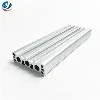
To speed up the alkali etching of aluminum profiles, you can add sodium nitrate or sodium nitrite, and then additives like sodium gluconate, to an alkali etching solution based on sodium hydroxide. Besides that, factors like the concentration of the bath, temperature, and etching time also affect the rate of industrial aluminum profile alkali etching, as well as how to control these factors.
Tank Solution Concentration
Dissolving sodium hydroxide in water creates an alkaline solution. This kind of solution is usually used as the chemical cleaning bath for aluminum profiles, also known as an alkaline etching solution. In the alkaline etching solution, the sodium hydroxide exists in a free ion state. As the concentration of sodium hydroxide rises to 250 g/L, the etching speed of industrial aluminum profiles also increases. This shows that the higher the concentration of sodium hydroxide in the tank, the faster the etching happens. However, many companies nowadays control the sodium hydroxide content in the range of 50–100 g/L to save costs. To control the sodium hydroxide content, a long-life additive can be added; for example, adding gluconate to the tank keeps the free sodium hydroxide content around 70 g/L.
Aluminum Dissolution Amount
Put the aluminum profile into a sodium hydroxide solution. The aluminum reacts with the sodium hydroxide to form aluminum hydroxide. The presence of this product slows down the corrosion rate of aluminum. Experiments have shown that when the aluminum dissolution amount is 26 g/L and the sodium hydroxide concentration is 50 g/L, the higher the temperature, the slower the aluminum corrodes. This shows that when the bath concentration stays the same, a higher aluminum dissolution amount leads to a slower corrosion rate, meaning the aluminum dissolution amount is inversely proportional to the corrosion rate. You need to calculate the proper aluminum dissolution amount, keep an eye on changes in the bath, and adjust the dissolution amount within the specified range as needed.
Tank Solution Temperature
From tests on 6063 aluminum profiles, we concluded that as the temperature of the tank solution rises, the rate of aluminum alkaline etching also increases rapidly. For every 10°C increase in temperature, the rate of aluminum etching doubles. So, the higher the temperature, the faster the etching rate, meaning the tank solution temperature is directly proportional to the etching speed. This is because etching aluminum in an alkaline solution is an exothermic reaction, releasing up to 20 kW/m² of heat. Usually, a cooling system with enough capacity needs to be installed to keep the solution temperature in the 50-60°C range, and in winter, this system can also serve as a heater.
Etching Time
In the alkaline etching reaction, the longer the industrial aluminum profile is etched, the greater the weight loss from aluminum dissolution. However, etching time doesn't have a direct relationship with etching speed-shortening the etching time only reduces the weight loss of dissolved aluminum and lowers the consumption of alkaline etching chemicals, but it doesn't affect the etching speed proportionally. If you want to get a smooth surface on aluminum profiles, you can first use mechanical brushing or sandblasting, or improve the mold quality and extrusion process to achieve a bright and even finish.