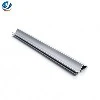
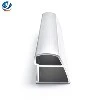
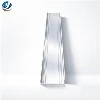
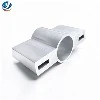
Aluminum profiles are produced from aluminum ingots through alloying, melting & casting, extrusion, heat treatment, surface finishing, and further machining. They serve as foundational components for window & curtain wall systems, industrial automation, heat sinks, photovoltaic supports, rail transit and other sectors. The full workflow covers six major stages: ingot casting, extrusion, heat treatment, surface treatment, deep processing, inspection and packaging. Understanding these processes helps with quotation, mold development and quality control for B2B and export orders.
1. Melting, Casting & Homogenization (Raw Material Stage)
Alloy Melting: High-purity aluminum ingots are melted together with alloying elements such as silicon and magnesium at 720–750°C for grades like 6063, 6061 and 6082. Degassing, slag removal and filtration are carried out to reduce hydrogen content and inclusions, preventing defects such as blisters, pinholes and cracks in later stages.
Semi-Continuous Casting: Molten aluminum is cast into solid cylindrical aluminum billets.
Homogenization: Billets are heated in a homogenizing furnace at around 570°C and held to eliminate casting segregation and balance alloy distribution. Homogenized billets extrude more smoothly with better surface quality and fewer color difference issues. This process is optional for regular orders but required for high-end projects.
Billet Sawing: Billets are cut into shorter lengths to match extruder capacity and order specifications.
Key note: Poor degassing during melting may cause white spots or dark discoloration after anodizing.
2. Mold Design & Fabrication (Core for Custom Shapes)
Molds are normally made of H13 hot-work tool steel and define the cross-section of profiles.
Simple solid profiles use flat dies; hollow profiles, complex heat sinks and LED channels mostly adopt porthole dies.
Molds go through CNC machining, quenching, nitriding and polishing. Trial extrusion and repeated mold adjustments are required to stabilize metal flow, ensuring uniform wall thickness and straight profiles without twisting or uneven material flow.
Mold service life and extrusion speed directly affect production costs. Custom complex profiles carry much higher mold expenses than standard industrial profiles.
3. Extrusion (Forming Stage)
Preheating: Aluminum billets and molds are preheated to approximately 450°C to achieve good plasticity and avoid sticking.
Extrusion: The heated billet is loaded into the extrusion container. Huge hydraulic force pushes aluminum through the mold opening to form continuous profiles with target cross-sections. Extruders range from 500 tons to over ten thousand tons; large-width and heavy profiles require high-tonnage presses.
Online Quenching: Profiles are cooled immediately after exiting the die. Air cooling and mist cooling are common for 6063-T5. Water quenching is used for high-strength grades such as 6061-T6 to lock the solid solution state for subsequent aging. Uneven cooling is a main cause of bending and twisting.
Stretching & Straightening: Cooled profiles are stretched slightly (0.5%–3%) to correct distortion and release residual stress, guaranteeing straightness, especially critical for curtain wall and industrial frame profiles.
Cutting to Length: Profiles are sawn to standard 6-meter lengths, or custom lengths of 3m, 4m etc.
4. Artificial Aging (Heat Treatment for Mechanical Properties)
Cut profiles are transferred to aging furnaces and kept at 170–200°C for several hours. Precipitation hardening improves hardness and tensile strength, forming T5 or T6 tempers:
T5: Air-cooled after extrusion then artificially aged. Widely used for 6063 architectural and decorative profiles with cost advantages.
T6: Water quenched after extrusion plus artificial aging. Higher strength for load-bearing structures, automation frames and PV brackets.
Under-aging leads to soft, easily deformed profiles; over-aging causes brittleness and reduced toughness.
After aging, raw mill-finish profiles are ready for direct shipment or surface finishing.
5. Surface Finishing (Corrosion Resistance, Color & Weather Resistance, Critical for Export)
Bare aluminum has limited corrosion resistance. Finishing options strongly impact pricing and outdoor performance:
Anodizing: Electrochemical process forming a dense aluminum oxide layer. Common film thickness: AA10, AA15, AA20. Available in silver, bronze and black. Good wear resistance with metallic texture, ideal for indoor trims, LED channels and edge profiles.
Electrophoretic Coating: A clear protective lacquer applied on top of anodized surfaces. Glossy, stain-resistant, widely adopted for windows.
Powder Coating: Electrostatic powder spraying followed by high-temperature curing. Wide color range, popular for exterior railings and interior decoration.
PVDF Coating (Fluorocarbon): Multi-layer fluorocarbon paint, excellent UV and acid rain resistance. Preferred for outdoor curtain walls and premium overseas projects with long service guarantees, at higher cost.
Wood Grain Transfer: Creates wood-like patterns on coated profiles for sunrooms and railings.
Mechanical Finishing: Sandblasting, brushing and polishing for decorative texture, not used as standalone anti-corrosion treatment.
Thermal break aluminum profiles require additional strip insertion or pouring to separate inner and outer aluminum sections for thermal insulation.
6. Secondary Machining (Deep Processing, Optional)
Many B2B customers require finished components. Machining operations are carried out before or after surface finishing: precision cutting, drilling, tapping, CNC milling, bending, welding, punching and grooving. Heat sinks, industrial frames and automotive aluminum parts usually need secondary machining.
7. Inspection, Packaging & Warehousing
In-process and final quality checks cover:
Dimension, wall thickness, straightness and twist tolerance
Surface appearance: scratches, blisters, color difference and indentations
Mechanical tests: hardness and tensile strength
Coating thickness and salt spray tests (often required for export orders) Qualified profiles are labeled, film-wrapped and packed. Export shipments are palletized to prevent scratches during transit.
Industry Summary
Melting & casting control hidden substrate defects; molds determine cross-section quality; extrusion and aging govern mechanical performance; surface finishing decides weather resistance and appearance. Standard profiles can be mass-produced. Custom extruded profiles incur extra costs mainly from mold making, repeated trial runs and parameter tuning. 6063-T5 is typical for architectural decoration, while 6061-T6 is for structural industrial parts. PVDF fluorocarbon coating is recommended for outdoor export projects.