1. What is aluminum profile extrusion mold opening
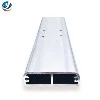
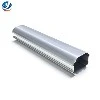
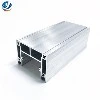
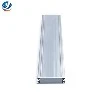
Custom aluminum extrusion die opening: Customers provide cross-section drawings (DXF/DWG) or samples. We manufacture dedicated H13 hot-work steel extrusion dies. Heated aluminum billets are extruded under high pressure to form non-standard one-piece profiles. Dies fall into two categories: solid dies and hollow porthole dies (for profiles with cavities & multi-cavity heat sinks).
Solid profiles: simple single-body cross-section, lower tooling cost & shorter lead time
Hollow profiles: with inner cavities & multi webs, e.g. sunflower heat sinks, higher tooling cost & complex design requirements
Common alloy grades
6063-T5: Preferred grade. Good extrusion fluidity, suitable for thin walls, complex fins & cosmetic parts with excellent anodizing finish. Widely used for heat sinks, enclosures, decorative trims and curtain tracks; moderate mechanical strength.
6061-T6: Higher structural strength for load-bearing supports & equipment housings. Harder to extrude; thicker minimum wall required for the same profile. Faster die wear and slightly poorer anodizing appearance.
6082-T6: High-strength grade widely adopted for structural parts in Europe & USA. Most difficult for extrusion; conservative cross-section design is required.
Full custom die process
DFM drawing review: Our engineers assess extrusion feasibility and optimize cross-sections (wall thickness, radii, cantilevers, cavities). This critical step avoids repeated die revisions later.
Die fabrication: H13 steel, including machining, heat treatment & nitriding.
Trial extrusion & first article → dimension & visual inspection.
Client sample approval
Aging, surface finishing (anodizing / powder coating / PVDF) & secondary machining (cutting, drilling, tapping, CNC).
Mass production.
Lead time reference:
Simple solid die: 10–15 days for samples
Complex hollow / heat sink porthole die: 20–30 days. Extra time needed if secondary die revision is required.
Mass production after sample approval: 15–25 days. Surface treatment and CNC will extend lead time accordingly.
Tooling cost & tooling ownership
Price factors: profile size, solid/hollow type, wall thickness, fin complexity, extrusion press tonnage
Simple solid die: several thousand RMB
Complex hollow / multi-fin heat sink die: over ten thousand RMB
Two common commercial models:
① Client pays full tooling cost: Client owns the tooling, factory keeps it in custody. Client may transfer the die later.
② Tooling rebate scheme: Factory refunds tooling cost once client purchases agreed tonnage within the valid period. Tonnage, validity term and ownership must be stated in contract. For export orders, include these clauses in PI & contract to avoid disputes.
Tool life: Nitrided H13 dies normally last tens of thousands to over one hundred thousand kilograms, depending on profile design and alloy grade.
Cross-section design guidelines
Keep wall thickness as uniform as possible. Large thickness variation easily causes twisting and unstable dimensions.
Replace all sharp corners with radius fillets to reduce stress concentration and extend die life.
Avoid overlong cantilevers and ultra-thin webs. Minimum wall ~1.0mm for 6063; ≥1.5mm recommended for 6061. Minimum wall must increase with wider profile circumscribed circle.
Hollow cavities cannot be too narrow. The height-to-thickness ratio of heat sink fins cannot be excessive to prevent tearing & deformation.
Leave allowance for surface finishing & machining. Anodizing causes minor dimensional change.
Circumscribed circle diameter must match extrusion press tonnage. Large profiles require higher tonnage presses.
MOQ
New custom die: MOQ normally 500–1000kg. Small trial orders are available with higher unit price. Small batches can be produced from existing standard dies without new tooling. We recommend checking our stock dies first to save tooling investment.
Surface finishes
Mill finish: raw extrusion
Anodizing: natural / black color, Qualanod standard available
Powder coating: RAL color chart
PVDF coating: high weather resistance for outdoor & architectural applications
Common industry pitfalls
Clients use CNC drawings directly for extrusion dies: CNC cross-section designs are not always extrusion-friendly. DFM optimization is mandatory; otherwise repeated die revisions will double costs.
Low-price tooling trap: Poor die steel or inadequate heat treatment leads to short die life and extra revision fees.
Verbal tooling rebate promise without written contract causes ownership disputes later.
Products we can manufacture
Sunflower heat sinks, air guide fins, aluminum support bars, industrial controller enclosures, curtain tracks, waterproof decorative trims, telescopic aluminum round tubes, 6061 / 6063 round & square tubes, ventilation grilles, etc. OEM custom die service available with one-stop secondary service including CNC, anodizing and coating.