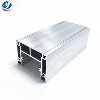
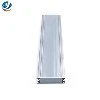
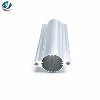
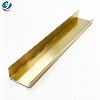
1. Basic Definition
6063 is an Al-Mg-Si series heat-treatable strengthened aluminum alloy. T5 Temper: Extruded at high temperature → air quenching for rapid cooling → low-temperature artificial aging (180–200℃, 2–3 hours), without separate solution heat treatment. It is the standard temper for architectural aluminum profiles.
2. Mandatory Mechanical Properties per National Standard GB/T 5237.1 (Architectural Aluminum Profiles, Minimum Guaranteed Values)
| Property Index | Minimum Standard Value | Typical Actual Measured Value in Industry |
|---|---|---|
| Tensile Strength (Rm) | ≥160 MPa | 170–185 MPa |
| Yield Strength (Rp0.2) | ≥110 MPa | 130–150 MPa |
| Elongation after Fracture (A50) | ≥8% | 9–12% |
| Vickers Hardness (HV) | ≥58 HV | 65–72 HV |
| Brinell Hardness (HB) | - | 60–68 HB |
| Webster Hardness (HW) | ≥8 HW | 9–11 HW |
General Physical & Mechanical Constants (Industry Standard)
Modulus of Elasticity (E): 69 GPa
Poisson's Ratio: 0.33
Density: 2.70 g/cm³
Fatigue Strength (5×10⁸ cycles): approx. 69 MPa
Linear Thermal Expansion Coefficient: 23.4 μm/m·℃
Thermal Conductivity: 209 W/(m·K)
3. Heat Treatment Principle & Property Characteristics of T5
Strengthening Mechanism
After extrusion and air cooling, Mg₂Si precipitates act as strengthening phases, delivering medium strength while retaining good ductility. Compared with T6 temper, T5 eliminates water quenching and solution treatment processes, featuring lower production cost and lower internal stress.
Advantages
Excellent ductility: suitable for bending, roll bending and arc stamping with low cracking risk, ideal for curved door/window and decorative special-shaped profiles
Superior extrusion fluidity, easy to form thin-walled complex cross-sections
Uniform coloring for anodizing, electrophoretic coating and powder coating with smooth surface finish
Outstanding corrosion resistance, free from stress corrosion cracking, the primary choice for outdoor doors, windows and curtain walls
Good weldability with slight strength drop after welding
Disadvantages
Lower strength than 6063-T6 and 6061-T6, not applicable for heavy-load bearing structures
Strength degrades significantly due to over-aging when service temperature exceeds 120℃
4.Core Property Comparison: 6063-T5 vs 6063-T6
| Parameter | 6063-T5 | 6063-T6 |
|---|---|---|
| Tensile Strength | ≥160 MPa | ≥205 MPa |
| Yield Strength | ≥110 MPa | ≥180 MPa |
| Elongation | 8–12% | 6–8% |
| Hardness | 60–68 HB | 75–85 HB |
| Bending Performance | Excellent, no easy cracking | Relatively hard, prone to micro-cracks during bending |
| Production Cost | Low (air cooling, short process) | High (water quenching + solution treatment) |
| Internal Stress | Low, less deformation after machining | High, easy warpage |
| Typical Applications | Doors, windows, curtain walls, decorations, heat sinks, light-duty frames | Equipment frames, bearing supports, PV brackets, heavy-duty industrial profiles |
5. Chemical Composition Standard
Si: 0.20–0.60% | Mg: 0.45–0.90% (core strengthening elements) Fe ≤0.35%; Cu/Mn/Cr/Zn/Ti ≤0.10%; Total Impurities ≤0.15%; Bal. Al The ratio of Mg and Si directly determines post-aging strength. Factories may fine-tune chemical composition to raise T5 yield strength to 140–150 MPa.
6. Main Industrial Application Scenarios
Construction Industry (Largest Consumption) Door & window frames, curtain walls, sunrooms, guardrails, decorative mouldings, blinds, handrails
Light Industry Heat Dissipation LED light troughs, heat sinks, air-conditioning heat dissipation tubes
Light-Duty Industrial Frames Simple assembly line supports, equipment outer decorative shells, PV frames, aluminum tubes
Furniture & Household Aluminum cabinet frames, partitions, bathroom profiles
7. Practical Inspection Standards in Industry
Sampling for mechanical test: longitudinal tensile test on profiles, uniform minimum standard values regardless of wall thickness
Rapid hardness inspection: on-site test with Webster hardness tester; HW <8 is unqualified
Common quality defects corresponding to performance issues
Under-aging: Tensile strength <160 MPa, low Webster hardness, prone to softening and deformation
Over-aging: Reduced strength, slightly higher elongation, dull surface
Insufficient cooling (natural cooling instead of forced air cooling): Coarsened strengthening phases, severely substandard mechanical properties
8. Material Selection Summary (Common Engineering Judgment)
For enclosure, decoration, light load and bending forming requirements: Select 6063-T5
For bearing supports, long-term stress bearing and high rigidity demand: Upgrade to 6063-T6 or 6061-T6