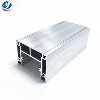
Modular aluminum extrusions (European/Chinese standard T-slot industrial aluminum profiles, mostly 6063-T5) – the service life of the extrusion body far exceeds that of matching connecting accessories. Industry consensus: For ordinary dry indoor industrial environments, anodized profiles have a design service life of 20–30 years. Many cleanroom and automation frame installations can serve over 30 years; only fittings require periodic replacement.
1. Reference Service Life by Application Scenario
Indoor standard factories / cleanrooms / workbenches / equipment frames (AA10μm anodizing)
20–30 years. Unlike steel, aluminum does not suffer progressive rusting, with only minor surface ageing. The main profile itself hardly fails. Wearing parts include bolts, T-nuts, angle brackets, sealing strips and panels (inspection and replacement generally required every 5–10 years).
Indoor humid workshops with cutting fluid or mild acid & alkali exposure
15–20 years. Thickened anodizing or powder coating is recommended.
Outdoor inland environments
15–25 years. AA15μm+ anodizing or powder coating required.
Coastal salt spray and chemical corrosive environments
10–18 years. Powder coating or electrophoretic coating is mandatory, with regular salt cleaning; otherwise pitting corrosion will occur and shorten service life significantly.
Bare aluminum without surface treatment
Only 3–8 years. Prone to white spots and pitting corrosion. Not recommended directly for industrial framing.
Key point: Modular aluminum extrusion is a reusable, dismountable system. Even after project decommissioning, qualified profiles can be disassembled and reused for reassembly, with high residual value and recycling rate over 95%. This is one of the core reasons why the automation and equipment industry increasingly adopts modular aluminum frames to replace welded steel frames.
2. Four Core Factors Determining Service Life
Alloy Grade: 6063-T5 for general use; 6061-T6 for heavy load; 6082 for high-load and outdoor projects.
Surface Treatment (most critical)
Standard anodizing AA10μm: indoor standard
AA15/20μm heavy anodizing: outdoor use
Powder coating & electrophoretic coating: high humidity, salt spray and chemical environments, superior corrosion resistance to regular anodizing
Load Design: Long-term overload beyond rated capacity causes plastic bending deformation and premature scrappage. Select profiles according to manufacturer's section load specifications.
Operating Environment: Salt spray, acid/alkali vapor, continuous high temperature and heavy abrasion accelerate damage to surface protective layers.
3. Recent Industry Trends
Automation equipment, new energy production line and clean factory projects are placing greater emphasis on whole-life-cycle cost. Although aluminum extrusions have higher upfront purchase cost than ordinary carbon steel, carbon steel needs rust removal and repainting every 2–3 years and full frame ageing within around 8 years. Aluminum frames feature long maintenance-free periods and lower overall long-term costs.
Environmental policies boost the popularization of modular aluminum extrusions. They can be disassembled, produce no welding fumes and scrap is recyclable to reduce solid waste. Many newly built smart manufacturing factories prioritize T-slot aluminum profile solutions for equipment safety guards and frame projects.
Clarification of common industry misconception: Many clients assume full aluminum frames must be replaced after 10 years. The profile body has a long lifespan; hardware accessories are the consumables. Replacing accessories regularly allows the frame main body to remain in service.
4.Short News Headlines
Modular Industrial Aluminum Extrusions Last 20–30 Years, Whole-Life-Cycle Advantages Stand Out
Material Selection Guide for Automated Production Lines: Service Life of T-Slot Aluminum Profiles Affected by Surface Treatment & Environment
Dismountable & Reusable, High Recycling Rate: Modular Aluminum Extrusions as Low-Carbon Structural Solution for Smart Manufacturing