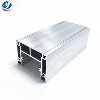
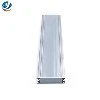
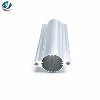
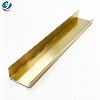
Recently, in exchanges in the aluminum profile deep processing industry, "whether extruded aluminum profiles can be polished" has become a hotly discussed technical issue. For this purpose, extruded aluminum profiles can be polished. As one of the core processes for surface finishing of aluminum profiles, polishing can effectively eliminate mold lines, slight scratches, oxide scale and surface uneven defects produced during the extrusion molding process, and greatly improve the flatness, smoothness and decorative performance of the profile. It is a key process for deep processing of mid-to-high-end construction, industrial and household aluminum profiles.
It is understood that extruded aluminum profiles are basic aluminum materials extruded through high-temperature and high-pressure dies. With the advantages of regular structure, strong toughness and stable precision, they have become the most widely used aluminum material category. However, due to the characteristics of the extrusion process, there are common fine extrusion lines, orange peel textures, local burrs and natural oxide layers of uneven thickness on the surface of raw extruded profiles. The raw matte texture is difficult to meet the high-gloss, mirror-level surface requirements in high-end decoration, precision equipment, new energy accessories and other fields. The polishing process is the core technical means to make up for its surface defects and enhance the added value of the product.
Three mainstream polishing processes adapt to the needs of different extrusion profile scenarios
At present, the industry has formed a mature polishing system for extruded aluminum profiles, which is mainly divided into three major processes: mechanical polishing, chemical polishing, and electrochemical polishing. The principles, effects, costs, and adaptation scenarios of the various processes are significantly different, and can accurately match different product positioning and production needs.
Mechanical polishing is the most commonly used physical finishing process for extruded aluminum profiles. It relies on abrasive belts, polishing wheels, abrasives and other equipment and tools to remove convex defects on the profile surface and smooth out extrusion lines through high-speed grinding, cutting and micro-shaping with controlled pressure. In the industry standard process, multiple processes of coarse grinding, medium grinding, and fine grinding are used for progressive processing. By adjusting the abrasive mesh number, equipment speed (800-2500 rpm) and processing pressure (0.05-0.5 MPa), different texture effects such as matte brushed, fine satin, and mirror high gloss can be achieved. The advantage of this process is that it has no chemical residues, natural surface texture, and stable corrosion resistance. It is suitable for conventional extruded profiles such as doors, windows, curtain walls, home profiles, and industrial frames. It is also a high-quality pre-treatment process for subsequent anodizing and powder spraying, which can greatly improve the uniformity and adhesion of subsequent coatings.
Chemical polishing is a liquid phase surface treatment process. The extruded aluminum profile is soaked in a special polishing liquid. Chemical reagents are used to selectively corrode the microscopic raised parts of the aluminum surface, quickly eliminating fine scratches, smoothing the surface, and achieving overall uniform brightening. This process has high processing efficiency and no mechanical polishing dead corners. It can perfectly process the corners and grooves of special-shaped extruded profiles and complex cross-section profiles that are difficult to reach with mechanical polishing. The disadvantage is that the surface texture uniformity is limited, the highlight effect is not as good as mechanical polishing, and the chemical liquid ratio and environmentally friendly treatment process need to be strictly controlled. It is mostly used for surface brightening of batch economical decorative profiles.
Electrochemical polishing is a finishing process for high-end extruded aluminum profiles. It combines electrochemical principles to perform ion-level leveling and brightening on the profile surface. Compared with traditional processes, its processing accuracy is higher, and it can completely eliminate microscopic textures produced by extrusion molding. The surface finish can reach mirror level, and a dense passivation film will be formed on the surface of the profile after polishing, which significantly improves the corrosion resistance and oxidation resistance. This process is mainly used in high value-added products such as new energy auto parts, precision medical equipment, high-end kitchen and bathroom profiles, and aviation lightweight extrusions. It is currently one of the core technologies for deep processing of high-end aluminum profiles.
At the same time, for hollow, thin-walled, oversized cross-section, and special-shaped extruded profiles, the polishing process needs to accurately control the processing intensity and process rhythm to avoid mechanical stress causing profile deformation and corner collapse. This is also the current core technical barrier for aluminum profile deep processing companies. High-quality manufacturers will customize exclusive polishing processes based on profile cross-sectional structure and wall thickness parameters to balance surface effects and product dimensional accuracy.
Industry trend: Polishing and finishing empowers the upgrading of the aluminum profile industry
In summary, polishing is an indispensable core process for the deep processing of extruded aluminum profiles. The technology has high maturity and is suitable for a wide range of scenarios. For manufacturing companies, accurately selecting polishing processes based on profile materials, product positioning, and application scenarios, and controlling base material quality and processing parameters are the key to increasing product added value and enhancing market competitiveness.
In the future, the extruded aluminum profile polishing industry will develop in the direction of "high precision, green and integrated". On the one hand, automated intelligent polishing equipment gradually replaces traditional manual polishing, achieving precise and controllable polishing parameters and greatly improving product consistency; on the other hand, the iteration of environmentally friendly chemical polishing solutions and low-energy electrochemical polishing technology effectively solves the environmental pain points of traditional processes and is in line with the green upgrade trend of the aluminum processing industry. At the same time, the composite surface treatment process of "polishing + anodizing, polishing + sandblasting, polishing + wire drawing" will further enrich the surface texture of extruded aluminum profiles and expand their application boundaries in high-end construction, smart equipment, new energy, light luxury home and other fields.
Polishing is an indispensable core process for deep processing of extruded aluminum profiles. The technology has high maturity and is suitable for a wide range of scenarios. For manufacturing companies, accurately selecting polishing processes based on profile materials, product positioning, and application scenarios, and controlling base material quality and processing parameters are the key to increasing product added value and enhancing market competitiveness.